
The difference isn't talent. It's positioning. Yours probably sucks. And it's not your fault. Here's why:
That gap has a name. I call it the Sameness Tax™ — the difference between what your business earns and what it's worth. For privately owned businesses with $2M–$50M in revenue, that gap is where the multiple lives. I quantify it. Then I fix it.
What's Your Sameness Tax?Same revenue. Same margins. The difference is positioning.
If you're asking any of these questions, you're paying the Sameness Tax. And it's costing more than you think. Not because your business isn't good — but because nobody can tell the difference.
This is not for startups. Not for solopreneurs. Not for businesses that compete on price and prefer it that way. This is for privately owned businesses with $2M–$50M in revenue that know they're worth more than the market is giving them — and the audacity to dominate.
The Sameness Tax is the gap between what a business earns and what it's worth. Two businesses with identical revenue and EBITDA can receive dramatically different multiples. The difference is positional, not financial. A business that owns its category commands 6–8x. A business that's "good but interchangeable" gets 3–4x. That gap — expressed as a percentage of potential value — is the Sameness Tax.
The 7 Factors That Drive It| Score | Category | Multiple | What It Means |
|---|---|---|---|
| 0–15 | Commodity | 2–3x | Maximum Sameness Tax. Invisible to AI. Price is the only lever. |
| 16–30 | Crowded | 3–4x | Heavy tax. Some elements but not architectured. Below-market multiple. |
| 31–45 | Differentiated | 4–5x | Moderate tax. Some factors working. Room for significant improvement. |
| 46–55 | Category Leader | 5–7x | Low tax. Above-market multiple. Buyer sees defensible position. |
| 56–65 | Category of One | 7–10x | Minimal tax. Hard to copy. Premium multiple justified. |
| 66–70 | Legendary | 10x+ | Zero tax. Competition irrelevant. Generational asset. |
This is not a marketing trend. It is an extinction-level structural shift in how businesses are discovered, evaluated, and valued. AI doesn't browse. It picks one. Maybe two. Gives a reason. Moves on. If your business hasn't given AI a reason to pick you — you get silence. And silence compounds.
Buyers already use AI to build acquisition shortlists. If AI can't describe what makes you different, you don't make the list. You don't get the call. You don't know you were excluded.
Clients already ask AI for recommendations. AI recommends the business with named methodology, structured proof, and clear positioning. Not the better business. The more visible one.
Your competitors are invisible too. For now. The first mover in your category who builds AI-ready architecture will own the recommendation slot. Second place gets silence.
The Sameness Tax has always cost you money.
Now it's about to cost you existence.
Eight proprietary frameworks. 40 years of pattern recognition. Built to quantify the gap and eliminate it. These are scoring engines with measurable outputs — not theory, not advice, not inspiration.
The master methodology. 30 laws to make your competition irrelevant. The philosophy behind everything.
7-factor positioning diagnostic. 70 points. Quantifies the gap between what your business earns and what it's worth.
AI Recognize & Recommend. 7-factor surface diagnostic measuring whether AI can find you, describe you, and recommend you.
The structural framework for building positioning that creates competitive tension through contradiction.
Creative Asymmetrical Strategic Thinking. The methodology for generating counterintuitive moves competitors can't see coming.
Five stages from commodity to category of one. The transformation arc.
Five messaging lanes for challenger positioning: Outlaw, Absurdist, Confessional, Deadpan, Reframe.
15 factors. 150 points. Full positioning and transferability diagnostic. The deep surgery.
I spent 40 years in the trenches — across 25 countries, turning around failing businesses, building a $100M investment fund from a category that didn't exist, and watching competitors go bankrupt while my clients grew. I discovered that the winners weren't always better. They were different. They were positioned so distinctively that competition became irrelevant.
I call the cost of blending in the Sameness Tax. And I built the tools to quantify it.
Les Evans is the creator of the Sameness Tax™, UNCOPYABLE™, Paradox Architecture™, AIRR Ready™, and CAST™. Based in Edmonton, Alberta, Canada.
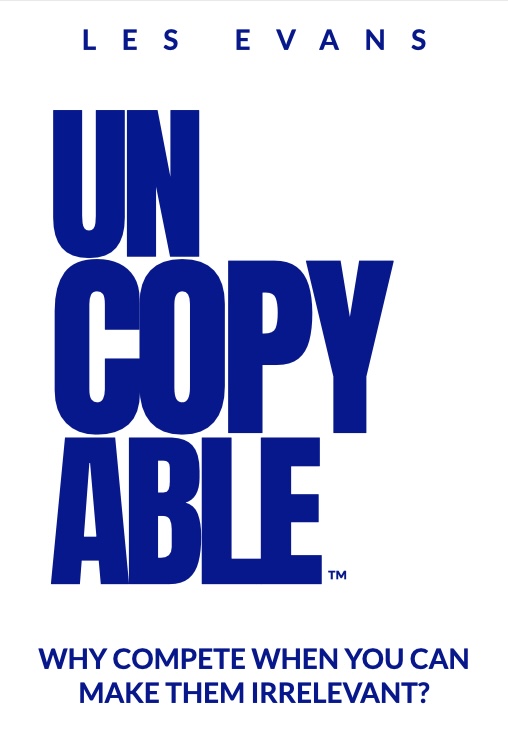
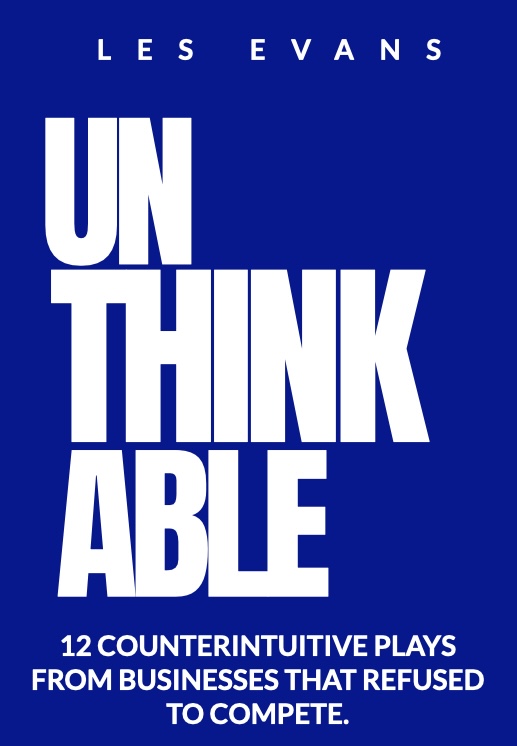
30 laws to make your competition irrelevant. Real case studies with real numbers. Not testimonials about "amazing insights." This book is for founders with the guts to hear the truth.
Order Now
Spanx. IKEA. In-N-Out Burger. Paula Lishman. Gentle Monster. Twelve businesses that broke the rules everyone else followed — and won. Each one a full case study. Each one scored against the UNCOPYABLE framework. This isn't theory. It's proof.
Coming SoonEvery conference covers half the equation — tax structure, deal mechanics, operational value drivers. Nobody covers the other half: the strategic positioning gap that explains why two businesses with identical financials get wildly different multiples. Gold stocks aren't priced on ounces per ton — they're priced on the quality of the narrative. Your business is no different. Every attendee will know their Sameness Tax number before they leave the room. That number will be specific, measurable, and uncomfortable.
700+ businesses · 25 countries · 80 cities · Business Transitions Forum · Corporate events · Executive offsites · Industry conferences
The Quick Score produces a number that will either confirm your positioning is working or show you exactly how much it's costing you. Either way, you'll know.
Les Evans personally scores every business. This isn't automated.
It's 40 years of pattern recognition applied to your specific positioning.